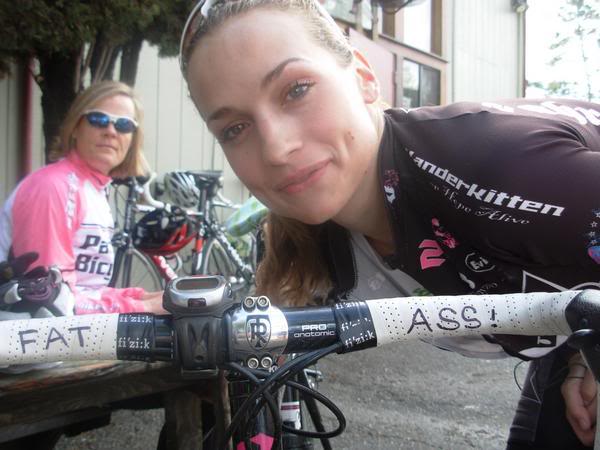
Because is something I still see, even in the people that say "I know how to ride"
1. Know Your Numbers
On the handlebars of a 21-speed bike (the most typical), you'll see a left-side shift lever with the numbers 1, 2 and 3, and a right-side shift lever with 1 through 7. The lever on the left controls the three chainrings on your front derailleur, and drastically change how easy or hard it is to pedal. The lever on the right controls the cluster of chainrings on your back derailleur and helps you make slight adjustments to your ride.
2. Use The Right Combos
"If you're climbing a steep hill, opt for lower gears?the 1 on the left side combined with 1 to 4 on the right,? says Joanne Thompson, owner and manager of Bike Station Aptos in Aptos, California. "If pedaling feels way too easy, switch to a higher gear?the 3 on the left side combined with 4 to 7 on the right?to help you go faster.? For everyday flat-road riding, she recommends sticking with the middle gear (the 2) on your left-side shifter and using the full range of gears on your right to fine-tune.
3. Shift Early, Shift Often
"Anticipate the road ahead and shift gears before a hill, just like you would in a manual-transmission car,? says Thompson. (Make sure to ease into gears, because if you make huge jumps?like clicking from the 1 on your left-hand shifter to the 3?your chain might slip off your bike.) "There's no such thing as shifting too often, so frequently change gears to find a cadence that's not too hard or easy,? she says. "Soon you'll be able to do it without thinking.?
The place to get the info on everything bike related. Community to share, place, discuss, meet and network. Here bikers will find the latest news and rides in the area. Let's have a blast doing what we love!
Monday, July 1, 2013
Thursday, June 27, 2013
Group Riding Tips
Keep these tips in mind the next time you go out to ride with a group.
• Be cautious of cars approaching from behind. The riders on the back have the responsibility of letting other riders know if cars are approaching. If there's not enough room to ride two-abreast, they should shout out to the group to go single file: "Car, single up!"• The key to an efficient pace line is to maintain speed. Fluctuations in speed quickly sap a group's energy just like when you're on your own doing a time trial. Try to maintain a constant, high speed.
• Stay relaxed and don't grip the handlebars too tight. The famous French cyclist Bernard Hinault used to say, "You should still be able to play the piano when riding." When you're tight and stiff your front wheel will go wherever your head turns. Look right and your bike will go right. But if you're relaxed you can look right and still hold a straight line. Holding a line is very important within the context of a group as each member is reliant upon the other members to maintain safety.
• Keep your head up. Watch for upcoming obstacles: cars, potholes, rocks, other riders, etc.
• Pull off into the wind as others may be overlapping your wheel to the draft side.
• Don't throw your bike back as you get out of the saddle. Stand up into the bike and bring the bike forward.
• Go easy on the brakes and anticipate pace changes. Try to reduce the accordion or "yo-yo" effect as much as possible.
• Recovery is key in a group rotation. Finding the right draft position and staying tight and close have a cumulative effect over time. Riders who know how to make use of the group will save enormous amounts of energy.
Individuals riding as a group can cover distances much faster than one individual and save energy at the same time, as long as the group works well together and safety remains the number one concern.
Wednesday, June 26, 2013
12 health benefits from cycling
Cycling is good for health. For one, it reduces death risks. In Denmark, a 15-year study associates cycling with a 40% reduction in mortality for both sexes over all ages (Archives of Internal Medicine, 2000).
Basically, a person who cycles as a commuter consistently can expect, according to a report released in a 1986 issue of the American Journal of Public Health, to live longer than those who don’t.
Cycling can also give you a high fitness level. The average daily cyclist has the fitness level of someone 10 years younger.
Cycling is good for your overall health in the following ways:
1. REDUCES weight when done regularly. Cycling increases calorie consumption and raises the metabolic rate, which can help to lose weight.
2. IMPROVES control of blood pressure by 10/8 mmHg in patients with hypertension (Journal of Cardiovascular Pharmacology, 1995).
3. LOWERS resting heart rate. A high resting heart rate has been linked to increased death from cardiovascular disease and increased risk of sudden death after a heart attack in healthy individuals.
4. IMPROVES HDL (good)/ LDL (bad) cholesterol ratio. If the ratio of LDL to HDL is too high, that means your blood is being loaded with cholesterol faster than the HDL cholesterol can remove it, which means excess cholesterol is building up inside the tissues and arteries. Eventually hardening of the arteries (atherosclerosis), which causes most heart attacks, takes place.
5. PREVENTS heart disease. Regular cycling halves the chance of suffering from heart disease, one of the top 3 killer diseases in Malaysia. A study reported a 50% reduction in fatal and non-fatal heart disease in civil servants who cycled over 20 miles/week.
6. BENEFITS cardiovascular health. Cycling also reduces the risk of stroke (a major killer in Malaysia) and coronary heart disease. In a study, regular exercise on a static cycle machine in patients with heart failure improves cardiac function (Lancet, 1990).
7. REDUCES diabetes. Exercise has been to shown to lead to a reduction in the rate of diabetes mellitus. In patients with diabetes mellitus, regular exercise leads to an improvement in control of blood sugar and can
help to prevent the onset of Type 2 diabetes mellitus.
8. REDUCES cancer. Physical activity has been shown to be associated with reduced rates of cancer (eg: bowel cancer, and possibly also breast cancer) (European Journal of Epidemiology, 2000).
9. REDUCES cholecystectomy (surgical removal of the gallbladder) rates in women (New England Journal of Medicine, 1999).
10. REDUCES anxiety, depression and stress (Preventive Medicine, 1988).
11. TRAINS respiratory muscles (Report of the Royal College of Physicians, London; 1991).
12. IMPROVES muscle strength. Cycling is a non-weight bearing activity and regular cycling leads to improved muscle strength and improved mobility and coordination (Allot & Lomax and the Policy Studies Institute, 1998).
Basically, a person who cycles as a commuter consistently can expect, according to a report released in a 1986 issue of the American Journal of Public Health, to live longer than those who don’t.
Cycling can also give you a high fitness level. The average daily cyclist has the fitness level of someone 10 years younger.
Cycling is good for your overall health in the following ways:
1. REDUCES weight when done regularly. Cycling increases calorie consumption and raises the metabolic rate, which can help to lose weight.
2. IMPROVES control of blood pressure by 10/8 mmHg in patients with hypertension (Journal of Cardiovascular Pharmacology, 1995).
3. LOWERS resting heart rate. A high resting heart rate has been linked to increased death from cardiovascular disease and increased risk of sudden death after a heart attack in healthy individuals.
4. IMPROVES HDL (good)/ LDL (bad) cholesterol ratio. If the ratio of LDL to HDL is too high, that means your blood is being loaded with cholesterol faster than the HDL cholesterol can remove it, which means excess cholesterol is building up inside the tissues and arteries. Eventually hardening of the arteries (atherosclerosis), which causes most heart attacks, takes place.5. PREVENTS heart disease. Regular cycling halves the chance of suffering from heart disease, one of the top 3 killer diseases in Malaysia. A study reported a 50% reduction in fatal and non-fatal heart disease in civil servants who cycled over 20 miles/week.
6. BENEFITS cardiovascular health. Cycling also reduces the risk of stroke (a major killer in Malaysia) and coronary heart disease. In a study, regular exercise on a static cycle machine in patients with heart failure improves cardiac function (Lancet, 1990).
7. REDUCES diabetes. Exercise has been to shown to lead to a reduction in the rate of diabetes mellitus. In patients with diabetes mellitus, regular exercise leads to an improvement in control of blood sugar and can
help to prevent the onset of Type 2 diabetes mellitus.8. REDUCES cancer. Physical activity has been shown to be associated with reduced rates of cancer (eg: bowel cancer, and possibly also breast cancer) (European Journal of Epidemiology, 2000).
9. REDUCES cholecystectomy (surgical removal of the gallbladder) rates in women (New England Journal of Medicine, 1999).
10. REDUCES anxiety, depression and stress (Preventive Medicine, 1988).
11. TRAINS respiratory muscles (Report of the Royal College of Physicians, London; 1991).
12. IMPROVES muscle strength. Cycling is a non-weight bearing activity and regular cycling leads to improved muscle strength and improved mobility and coordination (Allot & Lomax and the Policy Studies Institute, 1998).
Tuesday, June 25, 2013
Guidelines to successful group rides
One of the best parts of bicycling is stumbling upon a community of people who enjoy the simple pleasure of throwing a leg over a bike—and then doing that together. That’s right, I’m talking about group rides. Whether you’re riding the road in a peloton of your friends or storming the single track with a small army, group rides can easily be the best part of your week.
Or they can be the most challenging.
Getting a group of people together with varying skills and fitness levels creates a prime environment for good intentions to get in the way of good times. To avoid that fate, follow these tips to ensure everyone—whether they’re newbies or have been riding since the days of Biopace—has a great time on the next group ride.
1. Break up into groups.
Wanting to ride together in the name of inclusiveness is so nice and well-meaning, but it’s also the easiest way to screw up a group ride. When riders of varying skill and fitness stay together, no one ends up with the experience they were hoping for. Faster riders spend most of the ride waiting on slower folk, and then they often bolt before new riders can catch their breath.
Slower riders hate feeling like they’re making people wait. Even when the fast riders insist they don’t mind, they will never be able to convince novice riders. By breaking into groups, riders get to ride with (and learn from) their peers without pressure to wait, or more importantly, the pressure to keep up.
2. Create a “No One Gets Left Behind” group.
By promising not to ditch any of the riders on a group ride, you create a welcoming and engaging space. This brings an influx of new riders, which delivers a constant stream of fresh faces and new energy.
3. Learn by teaching.
The ideal person to lead the “No One Gets Left Behind” group isn’t the most skilled rider. It’s someone who recently joined the group. When ride leaders can relate stories of how far they’ve come in the past year and talk about when they, too, had trouble remembering which brake was which, it makes new riders feel comfortable and demonstrates how far a little practice can go. It gives new riders the opportunity to say, “If I keep practicing, in a year I can be where they are.”
Or they can be the most challenging.
Getting a group of people together with varying skills and fitness levels creates a prime environment for good intentions to get in the way of good times. To avoid that fate, follow these tips to ensure everyone—whether they’re newbies or have been riding since the days of Biopace—has a great time on the next group ride.
1. Break up into groups.
Wanting to ride together in the name of inclusiveness is so nice and well-meaning, but it’s also the easiest way to screw up a group ride. When riders of varying skill and fitness stay together, no one ends up with the experience they were hoping for. Faster riders spend most of the ride waiting on slower folk, and then they often bolt before new riders can catch their breath.
Slower riders hate feeling like they’re making people wait. Even when the fast riders insist they don’t mind, they will never be able to convince novice riders. By breaking into groups, riders get to ride with (and learn from) their peers without pressure to wait, or more importantly, the pressure to keep up.
2. Create a “No One Gets Left Behind” group.
By promising not to ditch any of the riders on a group ride, you create a welcoming and engaging space. This brings an influx of new riders, which delivers a constant stream of fresh faces and new energy.
3. Learn by teaching.
The ideal person to lead the “No One Gets Left Behind” group isn’t the most skilled rider. It’s someone who recently joined the group. When ride leaders can relate stories of how far they’ve come in the past year and talk about when they, too, had trouble remembering which brake was which, it makes new riders feel comfortable and demonstrates how far a little practice can go. It gives new riders the opportunity to say, “If I keep practicing, in a year I can be where they are.”
4. Choose your route wisely.The best tool in
your toolbag is the power to adapt (well, that and a patch kit).
Choosing rides that are easy to navigate, have bail-out points, and can
accommodate an unexpectedly large turnout will give you plenty of
options if a wrench is thrown into your plans.
5. Bring extra everything.It only takes one experience to realize that one person bonking, running out of water, or getting a flat tire can affect the entire group. While it’s every person’s responsibility to come prepared, having a bonus snack or tube can mean the difference between a short ride with a quick break or a long after-dark adventure home.

6. Build in a buffer.If you say the ride starts at 9AM, you’ll get two groups of riders – those who are chomping at the bit to ride at 9AM and those who are just rolling into the parking lot at 9AM. Instead, advertise that the ride meets at 8:45AM and leaves promptly at 9:00AM.
7. Go beyond the simple group ride.Bikes are fun. Themes are fun. Themed bike rides are definitely fun. Don’t be afraid to create a singlespeed ride or a ride for families with kids. You can throw together early morning weekend jaunts for parents who have limited time or let the hammerheads have a ride of their own where if you can’t keep up, you’re getting dropped. There’s grey-haired rides, singles rides, and rides where the pace starts slow and tapers back from there.
5. Bring extra everything.It only takes one experience to realize that one person bonking, running out of water, or getting a flat tire can affect the entire group. While it’s every person’s responsibility to come prepared, having a bonus snack or tube can mean the difference between a short ride with a quick break or a long after-dark adventure home.

6. Build in a buffer.If you say the ride starts at 9AM, you’ll get two groups of riders – those who are chomping at the bit to ride at 9AM and those who are just rolling into the parking lot at 9AM. Instead, advertise that the ride meets at 8:45AM and leaves promptly at 9:00AM.
7. Go beyond the simple group ride.Bikes are fun. Themes are fun. Themed bike rides are definitely fun. Don’t be afraid to create a singlespeed ride or a ride for families with kids. You can throw together early morning weekend jaunts for parents who have limited time or let the hammerheads have a ride of their own where if you can’t keep up, you’re getting dropped. There’s grey-haired rides, singles rides, and rides where the pace starts slow and tapers back from there.
Wednesday, January 16, 2013
Lance Armstrong..this and that. People get real!
For many years the sports industry has become just that... An Industry, a business and a highly competitive one. Not only due to the advances in engineering/ design of the apparatus involved on each sport, BUT mainly by the commercialization of the advertisement capabilities/rating for the media. Such gigantic pressure is immediately transferred to the athletes.
Just asked any full sponsored athlete (having the chance of dedicating your life to do what you love, without having to get a second job). Those companies will drop out at the first light of loosing media attention.
Now to Lance... HE IS A SUPER ATHLETE.. in his field. Doping or not PERIOD. In today's world professional competitions everyone (in one way or another is doping). Some never get caught, some do. There is many scientific advances but pushing the body to the limits we have seen all across the sport world in the last 15 years, needs some serious science.
Only him and the doctor knows the real truth, but WE have to realize that the commercialization of sports throughout media pushes this athletes to forget the fun factor of the sport. And that is our fault as spectators, giving sky high ratings to the events. (the same happens with celebrities/ movie stars and plastic surgery).
Lance has motivated thousands of people to get out and be active and those individuals started an exercise routine that it will change their lives for the better. Cycling or not. In the cycling industry/community, you just need to start and get on that bike and then...YOU ARE HOOKED FOR LIFE, Lance or no Lance. Once you start riding a bike there is no way out.
Wednesday, August 8, 2012
Reasons to take up cycling
Whether it's to boost your fitness, health or bank balance, or as an environmental choice, taking up cycling could be one of the best decisions you ever make. Not convinced? Here are some benefits of taking to two wheels.
1. You’ll get there faster
Commute by bike in the UK’s major cities and you’ll get there in half the time of cars, research by Citroen shows. In fact, if you drive for an hour in Cardiff’s rush hour, you’ll spend over 30 minutes going absolutely nowhere and average just 7mph, compared to averaging around 12-15mph while cycling.
2. Sleep more deeply
An early morning ride might knacker you out in the short term, but it’ll help you catch some quality shut-eye when you get back to your pillow. Stanford University School of Medicine researchers asked sedentary insomnia sufferers to cycle for 20-30 minutes every other day. The result? The time required for the insomniacs to fall asleep was reduced by half, and sleep time increased by almost an hour.
“Exercising outside exposes you to daylight,” explains Professor Jim Horne from Loughborough University’s Sleep Research Centre. “This helps get your circadian rhythm back in sync, and also rids your body of cortisol, the stress hormone that can prevent deep, regenerative sleep.”
3. Look younger
Scientists at Stanford University have found that cycling regularly can protect your skin against the harmful effects of UV radiation and reduce the signs of ageing. Harley Street dermatologist Dr Christopher Rowland Payne explains: “Increased circulation through exercise delivers oxygen and nutrients to skin cells more effectively, while flushing harmful toxins out. Exercise also creates an ideal environment within the body to optimise collagen production, helping reduce the appearance of wrinkles and speed up the healing process.” Don’t forget to slap on the factor 30 before you head out, though.
4. Boost your bowels
According to experts from Bristol University, the benefits of cycling extend deep into your core. “Physical activity helps decrease the time it takes food to move through the large intestine, limiting the amount of water absorbed back into your body and leaving you with softer stools, which are easier to pass,” explains Harley Street gastroenterologist Dr Ana Raimundo.
In addition, aerobic exercise accelerates your breathing and heart rate, which helps to stimulate the contraction of intestinal muscles. “As well as preventing you from feeling bloated, this helps protect you against bowel cancer,” Dr Raimundo says.
Subscribe to:
Posts (Atom)